Be yourself; Everyone else is already taken.
— Oscar Wilde.
This is the first post on my new blog. I’m just getting this new blog going, so stay tuned for more. Subscribe below to get notified when I post new updates.
Be yourself; Everyone else is already taken.
— Oscar Wilde.
This is the first post on my new blog. I’m just getting this new blog going, so stay tuned for more. Subscribe below to get notified when I post new updates.
It can be tough to provide an original or unique analysis of this text, especially because I think it has been picked over by many other people with way more enthusiasm. I will try nonetheless though.
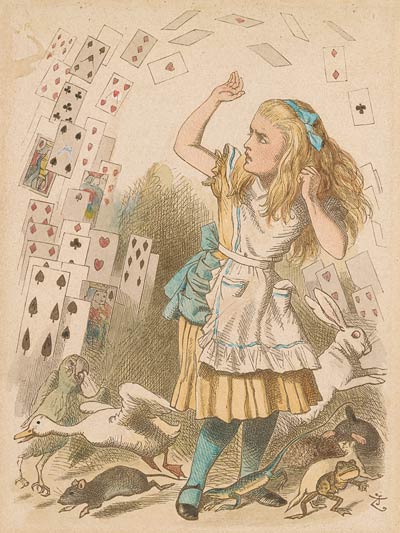
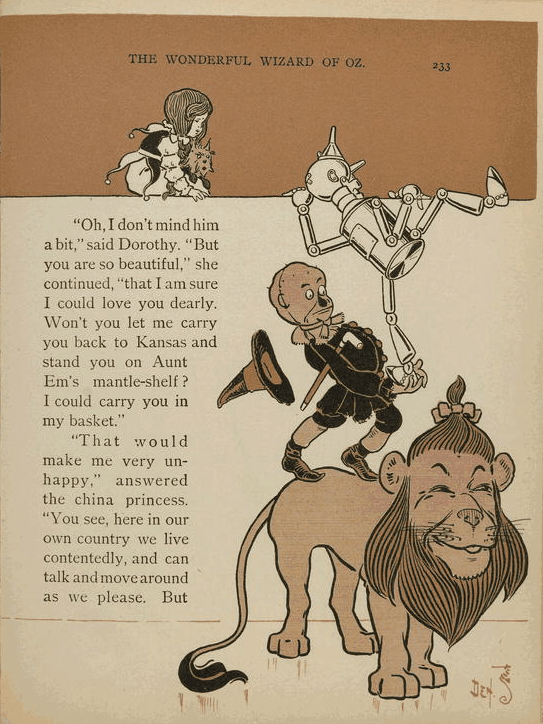
What I always find to be fascinating about The Matrix is how dense the entire film is of literary, mythological (which I won’t get into), and biblical references. From Neo being told to, “Follow the white rabbit,” to someone telling Neo that he is, “My own little, personal Jesus Christ,” to “It means buckle your seat belts, Dorothy. Because Kansas is going bye bye.” The entire film is loaded with all of these references and I’m going to see if I can unpack a few and what they mean.
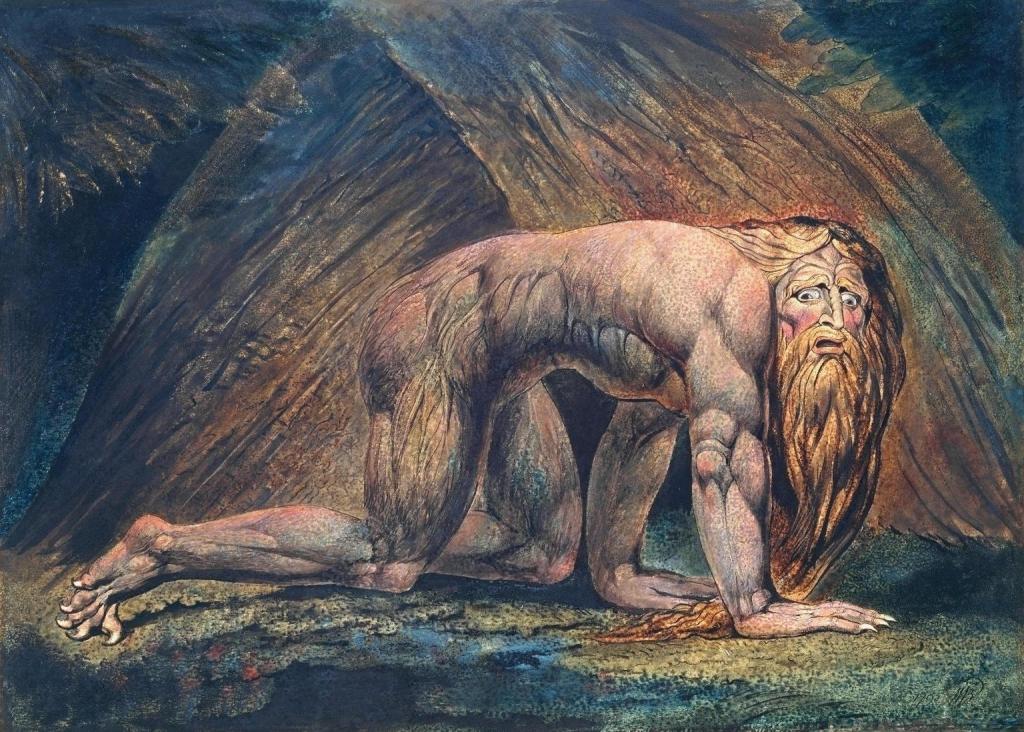
The Wachowski’s seemed to be very adamant, and not very subtle, when they began to write out the entire story and fill it with reference to all of these other texts. I think the Neo as a returning Jesus Christ figure and a savior is rather obvious so I don’t think I need to unpack that. How about the other biblical references though, like the name of their ship being called the Nebuchadnezzer. A Babylonian king who, within the Bible, is forced to walk on his four legs and eat grass. Ever since I was a kid I could never really formulate what they were trying to say with this. I also don’t have a confident answer now. Maybe to symbolize how derelict they ship is.
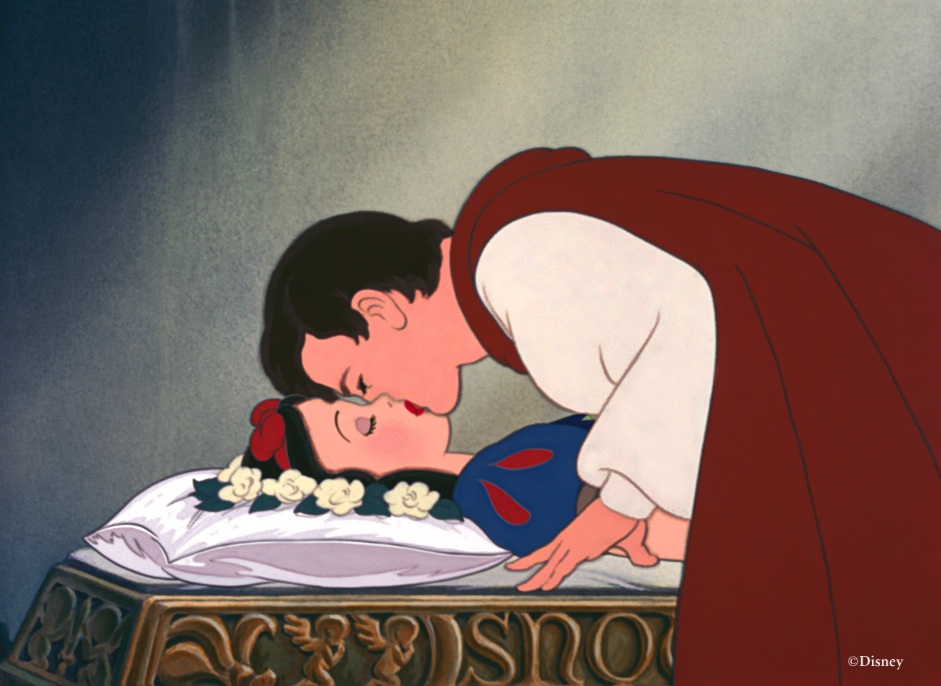
Or how about the ending of The Matrix. I doubt we are suppose to ignore the fact that it is true love’s kiss that revives Neo and brings him back to life. Perhaps The Wachowski’s are trying to tell us that even though their movie is a work of Sci-fi they really want it to be more like a fairytale. A new type of fairytale. They want it be more of a classic fantasy where Good defeats Evil, love abounds, and the humans are freed from their earthly torment and slavery. For all intents and purposes I think the Wachowski’s did exactly that.
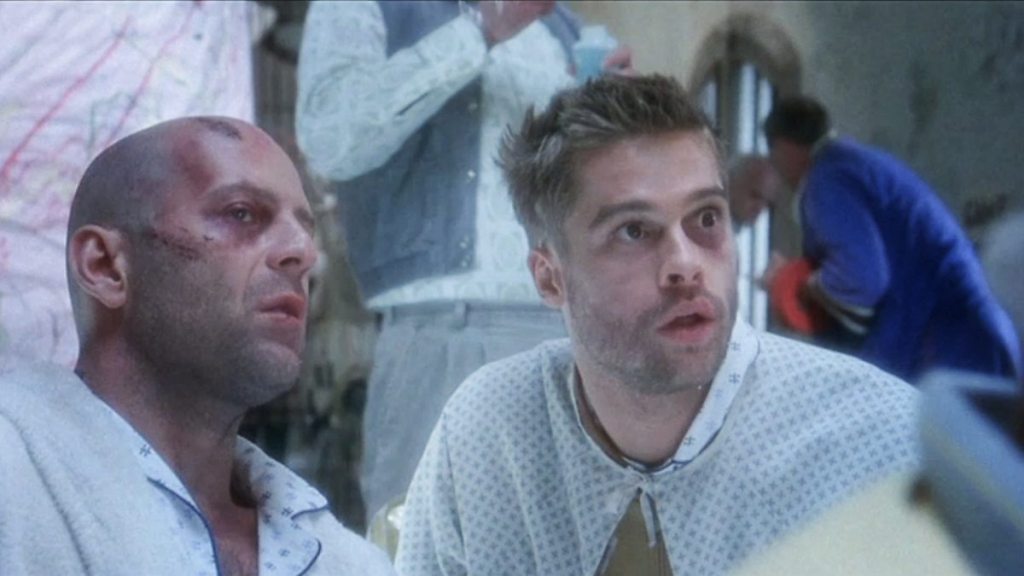
Something I continually find to be interesting about this film is the earlier portion of the movie regarding our characters in a mental hospital. How the narrative is framed we see everything from the protagonist’s point of view so we, like him, believe that he shouldn’t be in the hospital. This is something that many patients believe. Also considering the harsh conditions and abusive staff it makes sense as to why many of the patients wouldn’t want to be there.
A little over a year and a half ago I visited someone who was inside a mental hospital. I was able to walk with the patient I was visiting and got to see the inside of the facility rather well. It was small but it was essentially a prison for patients. What strikes me is that although the hospital within 12 Monkeys is more visually oppressive it is not too much of a stretch from where these hospitals are now.
This made me think about how 12 Monkeys really humanizes the mentally ill through the guise of science fiction. Through the narrative framing of the protagonist being a sane person we see how painful it could be being in his position. That although it is proved by the end that the protagonist is not insane the film still represents a truthful example of what it is like to be mentally ill in the United States. We get to see the sad truth that rests in many of these places and furthermore we get to see what happens to them when they get out. They find rest wherever they can but are often homeless and on the streets.
This is something I really appreciate about the film. It humanizes mental illness instead of romanticizing it.
Something that I find to be really clever about H.G. Wells’ work, The Time Machine, is how well it has aged. Despite being over a hundred years old it still has the ability to excite the reader and produce intrigue. This is due to Wells’ talent as an author and storyteller. What I find to be so fascinating is that although it is framed as a sci-fi story Wells’ writes it like an adventure novel. I feel like this might be overlooked by many modern day, American readers because we are so used to adventure storytelling that it has become the dominant story type within our pop culture. I’m doubtful though that this would’ve been so obvious over a hundred years ago. I’m thinking about other works like We and Metropolis that don’t frame their stories this way. The story seems to work more as an adventure story more so than sci-fi. For example if you replaced the time machine with some other form of transportation, like a boat, the story wouldn’t change too much and the adventure elements would still be apparent. Being stranded on an island with strange inhabitants has been told many times. I believe this focus on adventure, exploration, and action is what allows this work of literature to remain so long in the public eye. It is so readily accessible for modern audiences and it stems from not choosing to exhaust the reader with older, sci-fi concepts and instead focus on adventure.
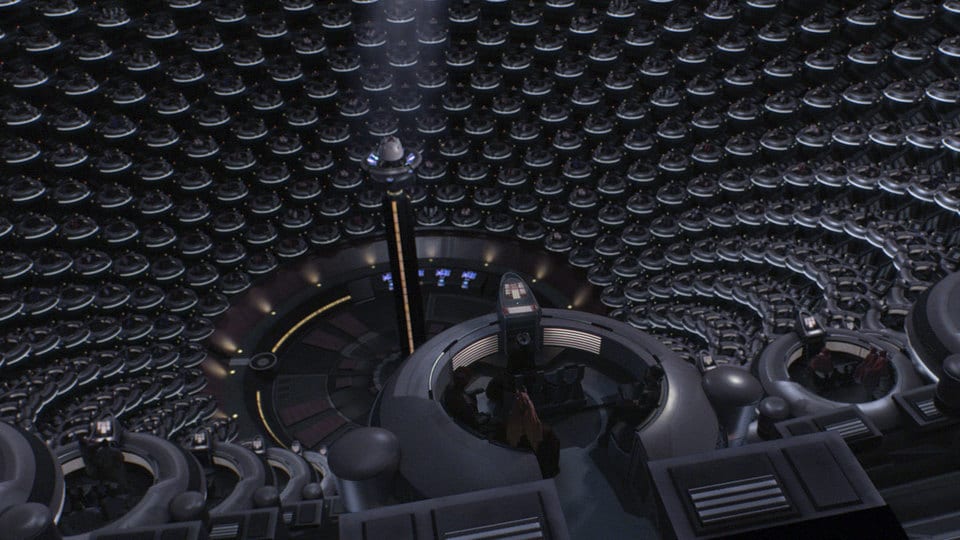
Space imperialism may seem too obvious a topic for modern viewers of sci-fi. George Lucas had his villains comprised of an empire in his original Star Wars trilogy. Politics in space though may be too difficult to make cinematic within a film. I don’t think we need to look further than Lucas’ attempt of this in his prequel trilogy. This was an effort which resulted in a bunch of aliens talking in a big room spouting phrases like, “Trade negotiations,” and “I love democracy.” As a kid I pressed forward on the VHS tape to get to the action in those films and as an adult I still don’t understand why these scenes are there.
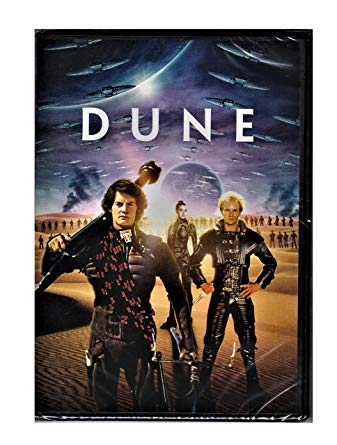
1984’s Dune faces the same problem. Now I’ve never read the novel, I’ve been interested for a little bit now, but from what I understand is that politics are a major part of it. Within the film we only understand the vaguest idea of how this empire is set up. They exposit enough within the film to make it somewhat understandable but I’m generally bored and am just waiting for Kyle MachLachlan to ride a gigantic worm into battle. What we get is a mixed narrative torn between politics, prophecies, warfare, and David Lynch’s sci-fi surrealism.
What’s sad is that I want to be able to witness proper, space politics within a film. I believe it can be done but it will take lots of work and a craftsman who is able to make it look cinematic; I think House of Cards was able to achieve this desired effect. It would also be so refreshing to see a sci-fi world that is dictated by governments and business’ much like our own little earth instead of it just being pushed off to the side or represented through our ever cliche dystopian stories. Here’s to hoping that Denis Villeneuve can do it.
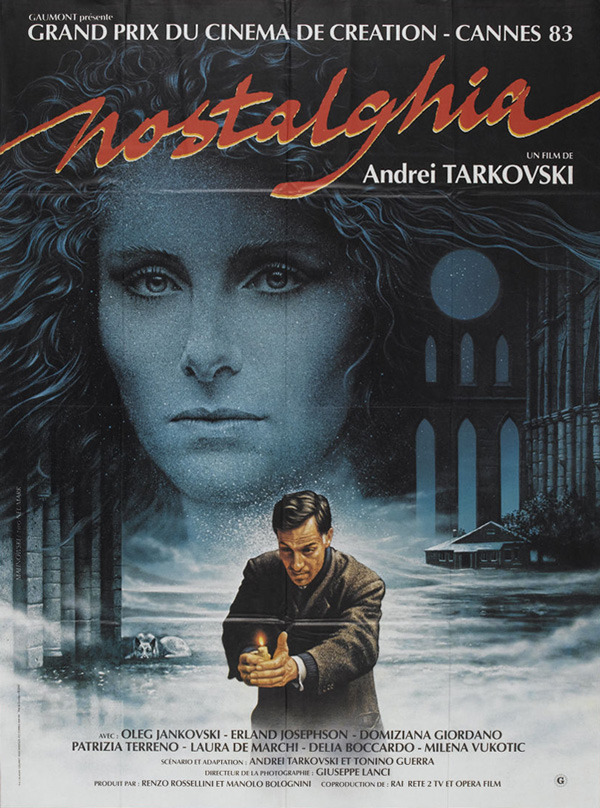
I had the privilege last summer to watch a 35MM screening of Andrei Tarkovsky’s film Nostalghia in theaters. I took someone with me who had never heard of the director or really knew what the film was about. I was thankful that they came but after 40 minutes into it they had fallen asleep.
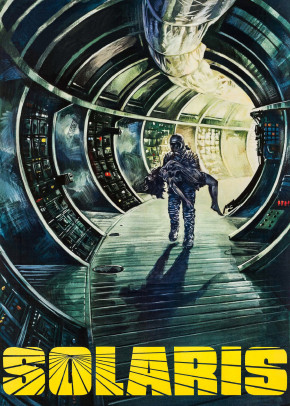
I always forget about this unapologetic slowness within Tarkovsky’s work. It is a part of his charm but, apart from Nostalghia in theaters, I’ve never been able to watch any of his works in a single sitting. While watching Solaris me and my girlfriend had to poke each other to keep awake. I wonder if this slowness, while essential to his aesthetic, is the best choice. The intentional, almost emptiness of his narratives and sequences leave so much to be desired. The lack of music, slowly spoken dialogue, and the intentional decision to leave gaps within his narratives certainly creates a poetic dreamscape but as well leaves much to be desired. It’s a shame, honestly. Don’t get me wrong I love his works having seen most of them. I also believe that it is the viewer who loses the most out of this slowness and not the director.
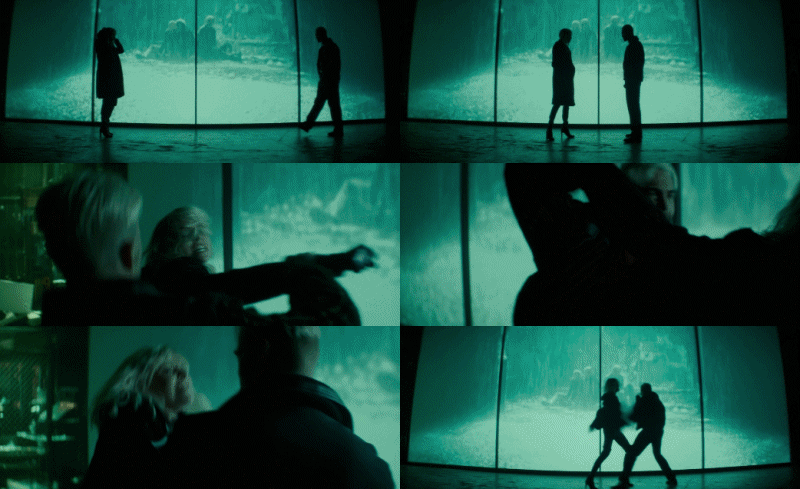
I would love to be able to show others Tarkovsky’s. To be able to get a group of friends together, go to the theater, and watch his films so that they too can enjoy his masterpieces but I can’t really. They would just all fall asleep. Especially if it was Solaris.
I’m no expert on silent films. I’ve seen my fair share. Probably seen more than the average fella my age. The silent medium presents several very interesting problems to the storyteller. Particularly how to demonstrate and have drama with no real dialogue. This gives birth to several silent tropes. A very common trope within this era, one I can’t stand, is the love triangle.
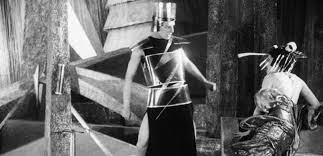
Aelita, Queen of Mars has two love triangles within the narrative. The reason for my disliking of this trope is how poorly the gender dynamics and politics have aged in the almost 100 year gap from when this was made. In particular the protagonist of the film, the male who’s intertwined in presumably two love triangles, is incredibly toxic and how he reacts to the triangles is deplorable. One, the more problematic triangle, is when he thinks his wife is cheating on him. Which meets its end when he JUST TRIES TO SHOOT HIS WIFE THEN COMES BACK TO HER AND ASKS FOR FORGIVENESS AND SHE ACCEPTS!!! WHAT!!!!! The other triangle is one born from his own personal fantasy. Which oddly enough, ends with him TRYING TO MURDER AELITA I DON’T UNDERSTAND! The reason why I hate these triangles is that I’ve spent a lengthy amount of words dictating this about a movie called Aelita, Queen of Mars. I’m not saying that films shouldn’t have love or love triangles but more often than not it will just entirely distract from the bigger ideas of your picture. This film, in particular though, certainly doesn’t make any useful commentary about love.

I find one particular element of this story to be fascinating. It is how the innocent, female characters are killed seemingly for the faults of man. This happens twice within the story. First is when the character of Manya is eaten by a snake. The second is when Marya is killed by a mob. It’s interesting how it is the female companions of the two scientists that are killed for the deeds of their husbands and they’re just innocent bystanders. The author seems to be stating that innocence will always die when men try to overreach their bounds. That innocence will die in the experimentation and innocence will die in the aftermath. It is odd though that these characters have little other relevance within the plot. I feel as though they are only written to compound the tragedy of the male protagonists. I’m not suggesting that the author is sexist or anything of the sort but by the end of the The Fatal Eggs it is the women who have to be killed for no good reason just so the men are punished for their sins.
I have this idea for a sci-fi property where time travelers all meet in a point of time in the future where all life on earth has almost been extinguished (from something like a nuclear holocaust or thereabouts) and nature has begun healing itself. These time travelers come to this location to escape from their war torn eras to live on an earth that’s peaceful. They find solace in the future instead of the past. The conflict arises from the amount of people wanting to try to colonize this future earth world, therefore giving rise to the possibility of open ended conflict and war happening again for the soil.
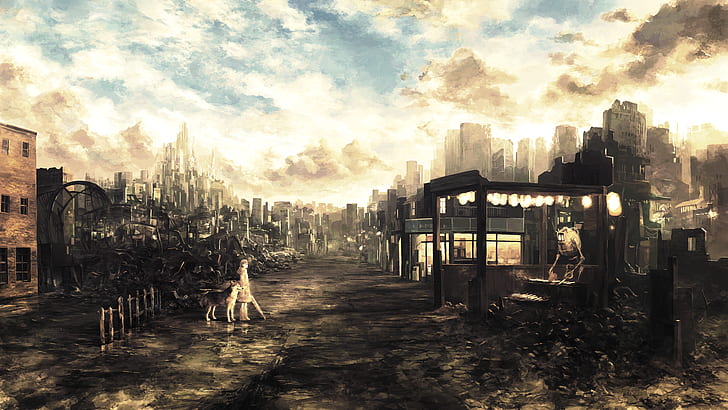
I find the narrator’s position in the story to be absolutely fascinating. Zamyatin writes the novel completely in the second person point of view. This is where the character of the story is directly telling us, the audience, the story. What I find to be so fascinating is that I’ve never seen this concept stretched out to longer than a short story. Within the novel D-503 is keeping a journal for work reasons and so that it can go onto his integral and be shipped off into new worlds and civilizations. This allows for the core prose of the novel to change depending on D-503s attitude, his emotional state, and the time when he’s writing his particular entry. Writing in the second person helps for expository reasons. Since D-503 is writing directly to us he can tell us all the pertinent information naturally. He also can add footnotes for clarity like on page 145 where the footnote was obviously written at a much later date than the entry. This allows for us to only see the prose as D-503 instead of Zamyatin in a more immersive way. It pulls us into the narrative and begs us to ask the question about how reliable our narrator is. So that everything that makes this text feel foreign and weird only adds to the story. This makes for the book being a more gripping and immersive read as opposed to if it was just told in the first person point of view.
This is a test post. Just to try and understand this site.

 Thomas' FORL 2220 Blog